What Drives the Cost of Custom Retail Fixtures? A Build-Up for Procurement Teams
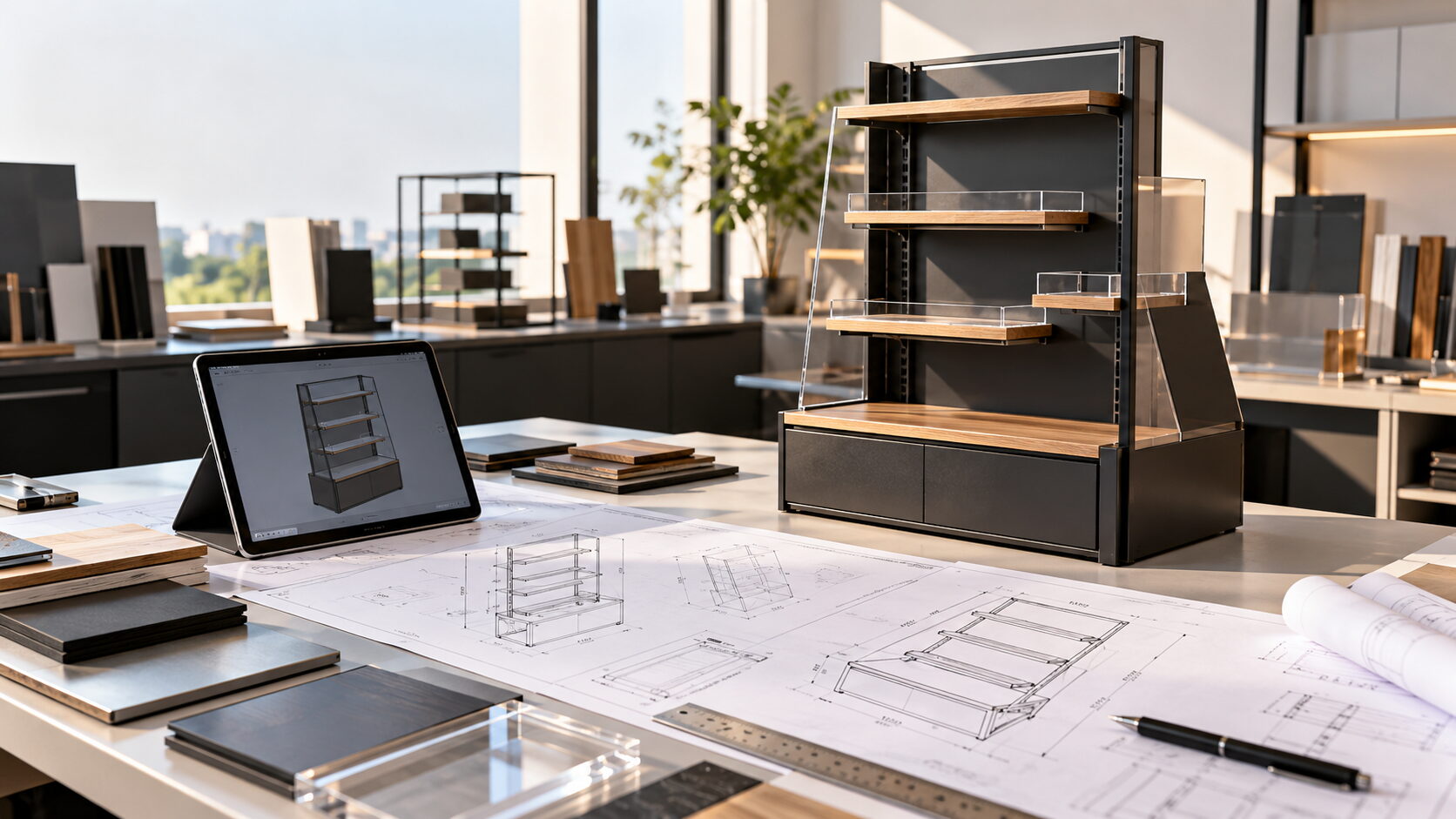
Two quotes for ‘a counter’ can differ by a factor of three, and both can be honest. A fixture is a collection of decisions: core board, face, edge, hardware, lighting, size, quantity, finish, delivery. Each decision has a cost, and quotes differ because those decisions were made differently.
This guide lists the factors that drive the cost of custom retail fixtures, shows how to build up a quote, and explains why unit price falls as quantity rises. For the full showroom budget, see our guide to showroom setup cost in India.
1. Material and core
Plywood, MDF, HDF, particle board and honeycomb differ in cost and in how long they last. A cheaper core on a high-traffic counter shortens its life. Our guide to edge banding and panel quality explains the trade-offs. Metal frames, acrylic and glass cost more again.
2. Face finish
Laminate, veneer, paint, metal finishes, acrylic and printed panels run from economical to premium. Direct UV printing can carry wood-effect or brand graphics onto panels. Specify finish by code and sample, not by name.
3. Size and complexity
Larger fixtures use more material and freight volume. Curves, mitres, lit elements and hidden fixings add machining and labour. A straight, repeated carcass costs less than a shaped unit.
4. Hardware
Hinges, runners, locks, brackets and levellers vary widely in quality and price. For heavy loads or frequent use, hardware is a place where cutting cost causes failures.
5. Lighting and electronics
LED strips, drivers, backlit panels, screens and security fittings add components, wiring and testing. They also add design time and a service requirement. Lit units cost more than non-lit units of the same size.
6. Quantity, tooling and set-up
Design, programming, jigs and set-up are spread over the run. Ten fixtures carry them ten ways. A hundred carry them a hundred ways. Ask for prices at several quantity levels, and ask whether tool cost is shown separately.
7. Design, drawings and prototype
Custom work starts with design. A prototype protects a rollout but costs time and money. Some vendors include it, others credit it against the order.
8. Packing, freight and installation
Flat-pack versus assembled, crating for fragile items, number of cities, access, and installation scope all change cost. Mall projects can add restricted working hours, material-entry procedures and deposits.
9. Timeline
A faster schedule costs more: extra shifts, parallel work and express transport.
10. Tax and commercial terms
Finished fixtures commonly attract 18 percent GST, which a GST-registered business can generally claim back with a proper invoice. Payment terms, warranty and spares also affect price.
How a quote is built up
| Line | What it covers |
|---|---|
| Design and drawings | Layout, 3D, shop drawings, approvals |
| Materials | Core, face, edge, metal, acrylic, glass |
| Hardware | Fittings, locks, runners, brackets |
| Lighting and electronics | LED, drivers, screens, wiring |
| Fabrication and finishing | Cutting, forming, assembly, edge banding, painting, printing |
| Tooling and prototype | Jigs, dies, sample |
| Packing and freight | Packing, transit insurance, delivery |
| Installation | Crew, access, travel, snag closure |
| Tax and margin | GST and the vendor’s margin |
Ask each vendor to quote against the same lines. Differences in a line then explain differences in the total.
How to lower cost without lowering quality
- Freeze the design before the BOQ.
- Standardise sizes across stores.
- Reserve custom work for brand-defining fixtures.
- Order long-lead items early.
- Choose finish for the real use of each fixture.
How quantity changes the unit cost
Unit cost = variable cost per fixture + (fixed set-up cost ÷ quantity). The arithmetic below is illustrative, with invented numbers, to show the shape.
| Quantity | Variable cost per fixture | Fixed set-up spread | Unit cost |
|---|---|---|---|
| 10 | ₹8,000 | ₹30,000 ÷ 10 = ₹3,000 | ₹11,000 |
| 50 | ₹8,000 | ₹30,000 ÷ 50 = ₹600 | ₹8,600 |
| 100 | ₹8,000 | ₹30,000 ÷ 100 = ₹300 | ₹8,300 |
The curve flattens. Beyond a point, more units change the price little, and design and finish decisions matter more. Replace the inputs with your vendor’s figures.
Reading two quotes line by line
- Compare core and face: same board grade and laminate thickness?
- Compare edge banding thickness and glue type.
- Compare hardware brand and load rating.
- Check whether lighting drivers and wiring are included.
- Check whether tooling and prototype are inside the unit price.
- Check packing, freight, installation and GST.
Where lines differ, ask the vendors to explain. A quote that is lower on materials and hardware may be cheaper because it is a lesser product.
Frequently asked questions
Why are custom retail fixtures expensive?
Because design, tooling and set-up are included, and each fixture is made to a specification. The gap narrows as quantity rises.
What affects fixture cost the most?
Material and core, size and complexity, finish, lighting, quantity and installation.
How do I compare fixture quotes?
Ask each vendor for the same lines: design, materials, hardware, lighting, fabrication, tooling, packing, freight and installation.
Does quantity reduce the price per fixture?
Yes, because set-up costs are spread over more units.
Does Beyond Retail publish prices?
No, because the cost depends on specification. It quotes against your fixture list.
Beyond Retail designs and fabricates custom retail fixtures in-house, so each line of a quote is under one roof. Send your fixture list and we will return a build-up you can compare. See turnkey showroom and fixture execution.
Related guides
- Why Brands Need a Single Retail Execution Partner
- Managing Multi-City Retail Rollouts in India: A Procurement Guide for Brands
- How to Choose the Right Retail Fixture Manufacturer in Delhi NCR
- 9 Hidden Costs in a Retail Fixture Quote (Most Brands Only Find Out After the Invoice)
- Edge Banding and Panel Pressing in Retail Furniture: Why Plywood, HDF and Honeycomb Board Quality Determines Store Lifespan