Retail Fixture Maintenance: Building a Repair-vs-Replace Programme for a Multi-Store Chain
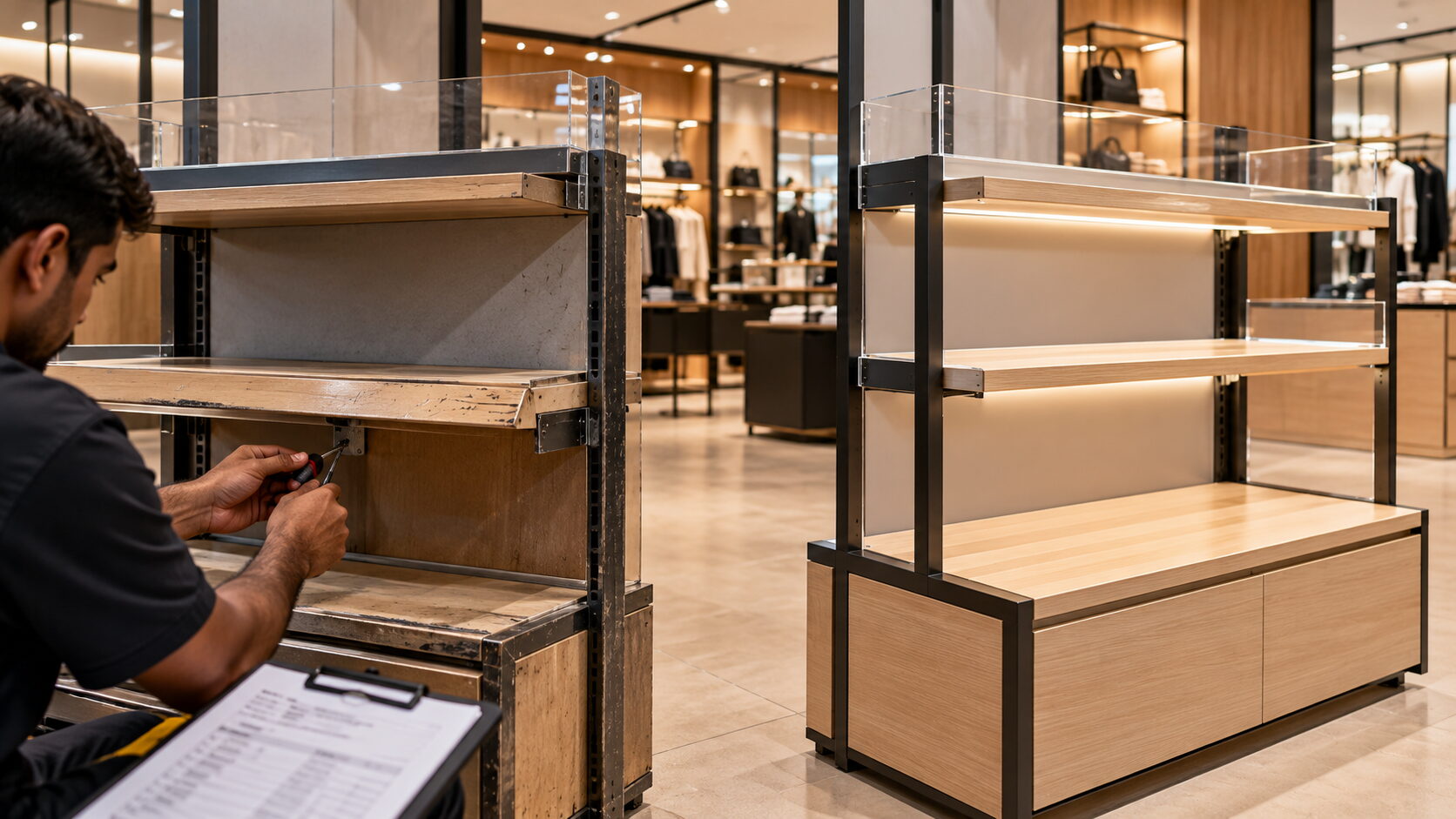
A fixture rollout usually gets careful planning right up to the day of installation, and almost none after. Six months later, a drawer sticks in one store, a laminate edge lifts in another, and a shelf bracket works loose in a third, each one handled as its own small emergency by whichever store manager happened to notice it first. None of this is unusual. What separates chains that keep their stores looking consistent from those that gradually don’t is whether maintenance is run as a programme or left to accumulate as one-off repairs.
What an AMC actually covers, and what it doesn’t
An annual maintenance contract is a service agreement under which a provider performs regular maintenance, inspections, and repairs on specified equipment for a fixed annual fee, and for retail fixtures that typically means scheduled inspection visits, routine tightening and adjustment, and labour for repair call-outs, within a response-time window stated in the contract. What it usually doesn’t cover, unless specifically negotiated, is spare parts, major rebuilds, or damage from misuse. The distinction between an AMC, which is mostly labour and inspection, and a comprehensive maintenance contract (CMC), which also covers parts and components, is worth settling explicitly in the contract rather than assuming the broader coverage, since a provider calling their offering "comprehensive" doesn’t guarantee it covers everything.
For a chain running fixtures across many stores, the contract should state the maximum response time for a breakdown call-out, since a guaranteed response window, such as a four-hour on-site commitment, is what actually determines whether a broken fixture is fixed before the next trading day or sits visible for a week.
Building a repair log that actually tells you something
A maintenance programme is only as good as the record behind it. The basic discipline is simple to describe and easy to let slide: log every repair with the store, the fixture model, the component that failed, the failure type, the date, labour and parts used, and photographs, noting whether the repair happened during trading hours or in an off-hours window. None of this needs special software to start; a shared spreadsheet is enough as long as every repair actually gets entered.
The payoff comes a few months in, once there’s enough data to review failure patterns by fixture model, component, store format and environment on a monthly or quarterly basis, which is what lets a chain catch a design or material problem before it affects every store rather than just the one that happened to report it first. If three stores report the same drawer slide failing within the same two months, that’s not three unlucky stores, that’s a component that needs to change in the next production batch.
The repair-vs-replace decision
Not every broken fixture is worth fixing, and not every worn one needs replacing either. A few questions, asked consistently rather than case by case, make the call clearer.
| Question | Leans toward repair | Leans toward replace |
|---|---|---|
| How old is the fixture relative to its expected service life? | Early in its life, isolated failure | Near or past the age the design was built for |
| Is this failure isolated or recurring across stores? | A one-off, likely mishandling | A pattern across multiple stores points to a design or material issue worth redesigning, not just patching |
| Does the repair cost approach a meaningful share of a new unit’s cost? | Repair is a small fraction of replacement cost | Repair cost creeping toward half the replacement cost or more |
| Is the fixture’s current design still the one you’d order today? | Design is still current and approved | Design has since been superseded by an improved version |
Keeping finishes and components consistent over time
A repair made two years after the original installation runs into a quiet problem: the laminate, hardware or acrylic grade the original vendor used may no longer be the current stock item. A chain that expects to repair fixtures over several years should ask its fixture vendor to hold reference samples of every approved finish on file, and specify in the maintenance contract that replacement components should match the original specification, or be flagged for approval if an exact match isn’t available. Without this, a repaired shelf in one store can end up a visibly different shade from the identical shelf next to it.
Who should hold the maintenance contract
The vendor who built the fixtures usually has the fastest route to a proper repair, since they already hold the drawings, the material specifications and often the tooling for repeat components. A third-party facility maintenance provider can be cheaper per call-out but typically works from what’s visible on site rather than the original specification, which raises the risk of a mismatched repair over time. For a chain with fixtures from a single vendor across most stores, keeping the maintenance relationship with that vendor, even as a separate contract from the original supply, usually pays for itself in consistency.
Budgeting for maintenance before it becomes urgent
There’s no retail-fixture-specific benchmark for what maintenance should cost, but the budgeting logic used for other commercial assets in India carries over reasonably well: maintenance cost is commonly planned as a percentage of the asset’s original purchase value, calibrated against the asset’s age and how critical it is to operations, rather than as a flat figure applied uniformly across a fleet of very different ages and conditions. A newly installed store’s fixtures need far less budget set aside than a five-year-old store nearing the end of its design life, and treating both the same either overpays for the new stores or underfunds the old ones.
What’s worth fixing in the contract itself: whether the AMC is labour-only, where the asset owner pays separately for parts, or comprehensive, where the provider absorbs parts cost as well, since the two models suit very different situations and the terminology isn’t standardised across providers, so the actual coverage needs reading in detail rather than assumed from the label. A comprehensive contract costs more upfront but gives budget certainty; a labour-only one is cheaper but leaves parts cost as a variable that’s hard to forecast for an older, less predictable fleet.
Beyond Retail builds custom retail fixtures in-house and can support ongoing maintenance for fixtures it has supplied, working from the original specification rather than an approximate match. If your stores are coming up on their first major maintenance cycle, or you’re setting up a repair log and AMC structure for the first time, get in touch with a sense of fleet size and age.