Retail Showroom Fit-Out Cost Breakdown in India: Per Square Foot CapEx Benchmarks (2026)
A cost per square foot is a shortcut. It is useful for a first budget conversation and dangerous as a contract figure, because two quotes at the same rate can include different work. This guide gathers the 2026 benchmarks published by Indian sources, explains why they disagree, and gives a worksheet to turn them into a capital expenditure budget for your own store.
It sits alongside our guide to showroom setup cost in India, which explains what quotes tend to leave out. Here the focus is the numbers and how to build them up.
What Indian sources publish for 2026
Four Indian sources give retail ranges. They are fit-out and shopfitting firms, not audited market data, so treat them as planning ranges.
| Source | Range quoted (per sq ft) | Notes |
|---|---|---|
| Sparrow PMC, 2026 guide | Basic ₹1,500 to ₹2,500. Standard branded ₹2,500 to ₹4,500. Premium ₹4,500 to ₹7,000. Luxury ₹7,000 to ₹12,000 or more. Refresh ₹700 to ₹1,800 | Covers interior execution, services, finishes, lighting and fixtures as scoped. Excludes rent, inventory, deposits, GST and major equipment |
| Keystone Building Concepts | Retail or boutique from ₹2,300 to ₹3,500, shown as a starting range | Turnkey model described as civil, MEP, joinery, finishes and branding |
| Axiom, retail shopfitting | ₹1,500 to ₹5,000 | Varies with materials |
| Holzbox, retail guide | Basic ₹800 to ₹1,500. Mid-range ₹1,500 to ₹3,000. Premium up to about ₹6,000 | Older, wider guide covering homes, offices and retail |
The sources overlap most between ₹2,300 and ₹3,500 for an ordinary branded store. They disagree at the edges because of what each counts. A rate that includes custom fixtures, lighting and signage is not comparable with one that stops at civil and finishes.
Why the ranges differ
- Scope: whether fixtures, signage, lighting, HVAC changes, IT and security are inside the rate.
- Format: jewellery, cosmetics, electronics and luxury stores need more security, lighting and custom work than a value outlet.
- Site condition: a warm shell with working HVAC, fire systems and electrics costs less than a bare shell.
- Location: mall stores can carry restricted working hours, material-entry procedures, deposits and approved contractors.
- Area basis: some rates apply to carpet area, others to leased or built-up area. On a 3,000 sq ft lease with 2,100 usable, the difference at a ₹1,800 rate is about ₹16 lakh. That example is from an office guide, but the arithmetic is the same.
- Date: a 2026 rate and an older guide are different things. Re-check anything dated before this year.
Budget by store size
One 2026 guide turns its ranges into budgets by size. Larger stores do not always cost proportionately more, because fixed items such as electrical panels, signage development and approvals are spread over more area. Extensive fixtures can push the total up again.
| Store size | Basic | Standard branded | Premium |
|---|---|---|---|
| 500 sq ft | ₹7.5 to ₹12.5 lakh | ₹12.5 to ₹22.5 lakh | ₹22.5 to ₹35 lakh |
| 1,000 sq ft | ₹15 to ₹25 lakh | ₹25 to ₹45 lakh | ₹45 to ₹70 lakh |
| 2,000 sq ft | ₹30 to ₹50 lakh | ₹50 to ₹90 lakh | ₹90 lakh to ₹1.4 crore |
| 5,000 sq ft | ₹75 lakh to ₹1.25 crore | ₹1.25 to ₹2.25 crore | ₹2.25 to ₹3.5 crore |
Source for the table: Sparrow PMC’s 2026 retail fit-out guide. These are planning ranges, not quotations. A detailed BOQ and site survey come first.
Where the money goes
Only one head has a published share. The same guide says civil and interior works may account for roughly 20 to 30 percent of the fit-out budget. The other heads are listed without percentages, and we could not find a reliable Indian retail split for them, so none is invented here. The practical way to get one is to ask each vendor for a trade-wise BOQ total and calculate the shares yourself.
| CapEx head | Typical items | How to price it | Your share (fill in) |
|---|---|---|---|
| Civil and interior | Partitions, flooring, ceiling, wall finishes, doors, trial rooms, cash counter | BOQ by quantity. About 20 to 30 percent per the guide above | |
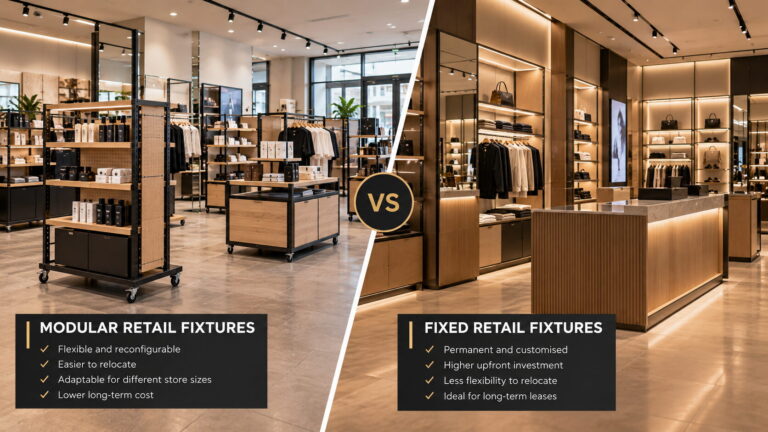
| Fixtures and furniture | Wall systems, gondolas, shelving, tables, counters, storage, custom units | Fixture schedule by count and size. Often one of the largest heads | |
| Electrical and lighting | Wiring, distribution boards, track lights, emergency lights, controls, earthing | BOQ plus lighting design | |
| HVAC, fire and plumbing | AC changes, fresh air, sprinkler or alarm relocation, drainage | Depends on shell condition and landlord scope | |
| Facade, branding and signage | Glazing, illuminated sign, cladding, window display, internal graphics | Sign schedule and print area | |
| IT, security and technology | CCTV, data cabling, POS points, article surveillance, screens, music | Vendor quotes, often outside the main contractor | |
| Design and project management | Design fees, PMC | Fixed fee or percentage |
Worked example, using one source’s ranges
Take a 1,000 sq ft standard branded store. The size table gives ₹25 to ₹45 lakh. Add a contingency of 5 to 10 percent, which the same guide suggests: that makes ₹26.25 to ₹49.5 lakh. Civil and interior works at 20 to 30 percent of the base would be roughly ₹5 to ₹13.5 lakh of the total. None of that includes GST, deposits, rent, inventory, equipment or design fees, which the guide lists among commonly excluded items.
This is an illustration built from one source’s ranges. Your own BOQ will replace it. The value of the exercise is to see how wide the band is, and how much sits outside it.
Costs that sit outside the rate
Confirm in writing whether each of these is included: GST, rent and deposits, inventory, design consultancy and PMC fees, landlord or mall deposits, statutory approvals, loose equipment, internet and software, launch marketing, utility connections, insurance and post-handover maintenance. The same guide notes that missing exclusions are a common reason the approved budget differs from the final cost.
Timeline affects cost
A faster schedule costs more: extra labour, parallel working, express transport and quicker decisions. Indicative execution periods in the 2026 guide are 15 to 30 days for a small shop or kiosk, 30 to 50 days for a standard store up to 1,500 sq ft, 45 to 75 days for a medium branded store and 60 to 120 days for a large or premium one, usually counted after drawings, BOQ and approvals are ready. A separate Keystone page gives 30 to 45 days for a 500 to 1,500 sq ft retail outlet. See our turnkey fit-out process for how the stages fit together.
How to lower the number without lowering the standard
- Freeze scope and drawings before the BOQ. Changes during finishing are the most expensive.
- Compare quotes on equal scope. A lower quote may simply leave work out.
- For several stores, use standard drawings, modular fixtures, approved materials, bulk orders and a rate card. See the rollout plan.
- Order long-lead items early: fixtures, lighting, glass and signage.
- Check whether interior design and execution are bought together or apart: interior design versus turnkey fit-out.
Frequently asked questions
What is the average retail fit-out cost per square foot in India in 2026?
Published ranges put a standard branded store at about ₹2,500 to ₹4,500 per square foot. Basic stores start near ₹1,500 and premium formats run from ₹4,500 to ₹7,000, with luxury formats above that.
Does the rate include furniture and fixtures?
It depends on the quote. Some rates include fixed display fixtures and counters but exclude loose furniture and equipment. The BOQ should list every inclusion and exclusion.
How much contingency should a store budget carry?
A 5 to 10 percent contingency is commonly advised, with more for renovations, older properties and fast-track work.
Why do mall fit-outs cost more than high-street ones?
Mall projects can involve restricted hours, material-entry procedures, deposits, safety compliance and approved contractors. High-street sites can also cost more if the existing infrastructure needs upgrades.
Can the cost per store fall in a multi-store rollout?
Yes, through standard drawings, modular fixtures, approved materials, bulk procurement and repeat vendors, provided the specification stays consistent.
Beyond Retail does not publish a rate card, because the figure depends on scope, materials and quantities. It designs and fabricates fixtures, signage and printed graphics in-house and executes turnkey showrooms. If you have a layout, a city and a format, send your layout and we will return a quote structured against a BOQ so each head can be compared. See also how turnkey showroom and fixture execution is organised.