Edge Banding and Panel Pressing in Retail Furniture: Why Plywood, HDF and Honeycomb Board Quality Determines Store Lifespan
A counter that looks right on opening day and is chipped, peeling and sagging within a year has usually not failed on the surface. It has failed in the parts a buyer rarely sees: the core board, the way the laminate was bonded to it, and how the edges were sealed. Those are manufacturing decisions, and they decide whether a fixture survives a five-year lease or needs patching from the first season.
This guide explains how a durable retail panel is built, why edges are the usual point of failure, what the common core boards do and do not do, and how to specify and inspect the work.
Anatomy of a retail counter panel
| Layer | Job | Common choices | How it fails |
|---|---|---|---|
| Core | Carries load, holds screws and hardware | Plywood, MDF, HDF or HDHMR, honeycomb board, particle board | Swelling, sagging, screw pull-out |
| Face | Wear surface and look | High-pressure laminate, melamine, veneer | Chipping, scratching, lifting |
| Bond | Joins face to core | Adhesive under controlled pressure | Bubbling, delamination |
| Edge | Seals the cut core | PVC, ABS or veneer edge band | Chipping, peeling, moisture ingress |
| Hardware | Hinges, runners, locks | Quality fittings with correct fixings | Loosening and misalignment |
Why edges fail first
The face of a panel is protected by laminate. The edge is where the core is exposed, and it takes the knocks from bags, elbows, trolleys and cleaning. One guide explains that moisture enters the edge far more easily than the face and travels sideways into the board. That is why edge banding does more than finish the look. It protects the substrate from moisture and wear and prevents chipping and delamination.
Core boards, and what each is good for
| Core | Strengths | Limits | Retail use |
|---|---|---|---|
| Plywood | Holds screws and keeps its shape better in damp service | Edges show plies and must be banded | Counters, shelving, load-bearing panels |
| MDF | Machines cleanly, takes paint and has excellent edge quality | Poor moisture resistance, swells when wet | Dry interior panels and shaped parts |
| HDF or HDHMR | Denser, harder fibre core, moisture-resistant grades exist | Porous cut edge still needs sealing | Wall panels and fixtures where a dense core is needed |
| Honeycomb board | Very light, suited to tall doors and wall-hung panels | Poor screw holding, so it needs specialty hardware | Large wall panels, partitions and light shelves |
| Particle board | Smooth lamination surface at the lowest cost | Poor edge and moisture performance | Low-load, low-contact panels |
The rule that follows is simple: match the core to the load and the moisture risk. A cash counter and a product table take weight, screws and knocks, so a plywood or dense fibre core is safer. A wall panel that carries only a graphic can use a lighter board.
Panel pressing: how the face is bonded
Laminate or veneer is bonded to the core with adhesive under pressure. In cold pressing the panel is pressed with adhesive at controlled pressure without heating, which keeps panels flat and bonds evenly when the process is controlled. The result depends on clean cores, correct adhesive spread, even pressure and enough pressing time. Poor pressing shows up later as bubbling, lifting corners and a face that separates at the edge. These points are general manufacturing practice, so ask the vendor to describe their own process and show a cut-through sample.
Machine edge banding versus manual pasting
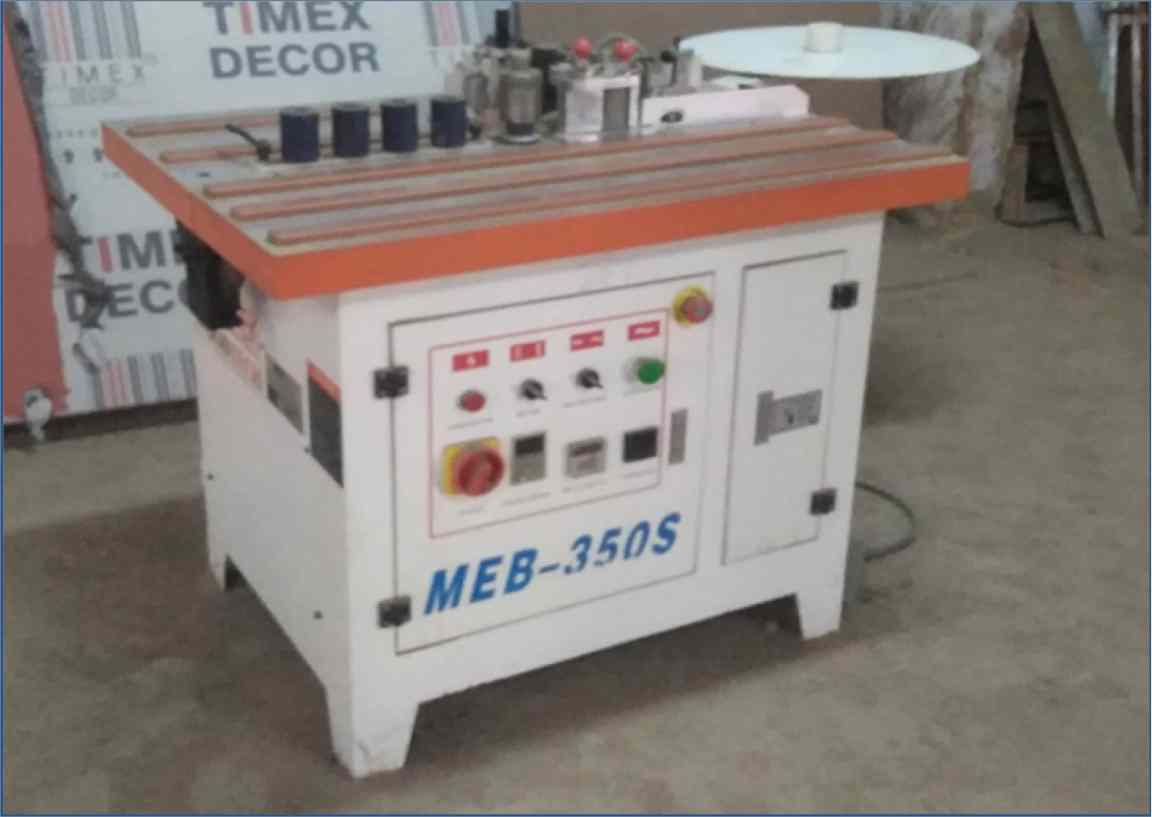
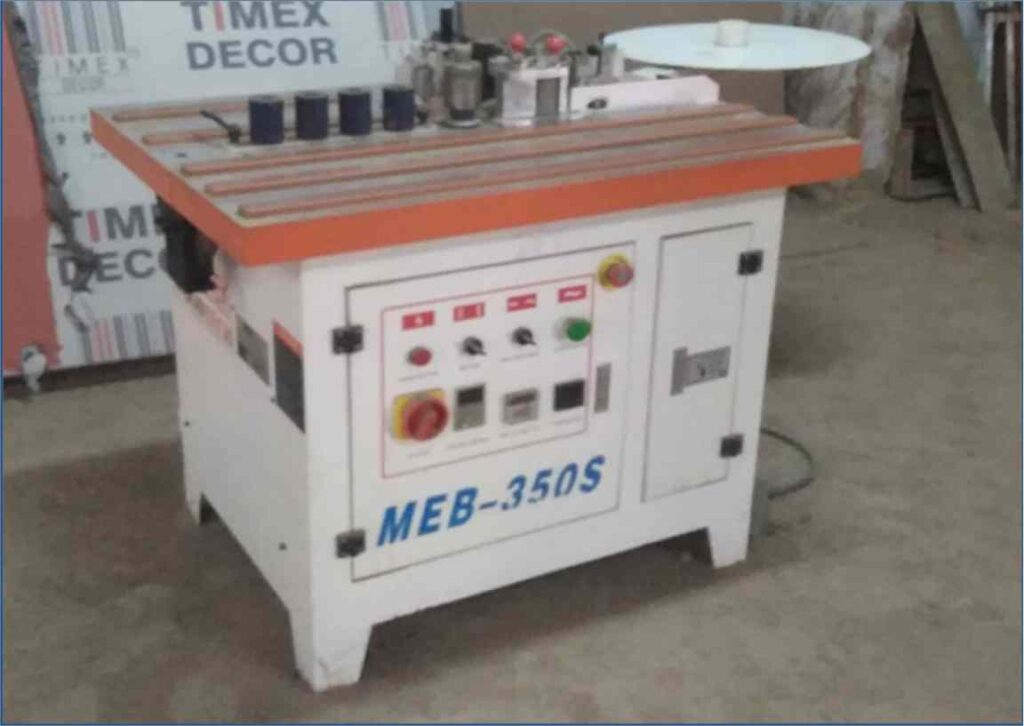
On a modern edge bander, hot-melt adhesive is applied to the edge or tape, the band is pressed on and the excess is trimmed, all in one controlled pass. Most edge banders use hot-melt glue, and polyurethane reactive (PUR) glue is a premium option that forms a strong, water-resistant bond. Manual pasting depends on the worker’s hand, so glue spread, pressure and trimming vary. A guide to the failures lists their causes: a cold or dusty edge, weak glue, low pressure, and heat or water exposure. Machines control most of these, and the fix for the rest is pre-milling and correct glue temperature.
Choosing the edge band
| Option | Notes |
|---|---|
| PVC | Robust, moisture-resistant and inexpensive, and bonds well with hot-melt |
| ABS | Similar durability without chlorine, and works with laser or hot-air edging for a seamless joint |
| Veneer or paper strips | Natural look for veneer, but poor moisture resistance. Thin melamine paper strips chip at corners |
| Thickness | 1.5 to 2 mm PVC or ABS for high-impact environments, and 2 to 3 mm for reception counters and desk tops in one guide. Very thin 0.4 to 0.6 mm tape suits low-contact edges |
| Glue | EVA hot-melt for most dry interior work, PUR for kitchens, bathrooms and wet or changing environments |
One supplier states that commercial-grade edge banding of 3 mm PVC or ABS lasts 10 to 15 years or more under normal commercial use. Treat that as a vendor claim. The useful point is that contact edges on a retail counter should not be specified at the thinnest tape.
The five-year cost of cutting corners
Poor panels cost money in three ways. Repairs and replacements through the year, as covered in our guide to fixture maintenance and repair. Visible damage in the first stores of a network, which hurts brand quality at the places customers see most. And early refits, which turn a one-time fit-out into a recurring cost, which is why the showroom setup cost should be judged over the lease and not on the opening quote. A fixture priced lower because the edge is a thin tape on a weak core may cost more across a five-year lease, once repairs, downtime and replacement are added.
How to specify and inspect
- Core board type and thickness for each fixture, not a general ‘board’.
- Face laminate type, thickness and colour code, with approved samples.
- Edge band material and thickness by edge: thicker on contact edges, thinner on hidden edges.
- Glue type, with PUR in wet areas and for edges near cleaning or water.
- Machine banding and a statement of the pressing method.
- Hardware brand, load rating and the fixing method to the core.
- Inspection: a cut-through sample, a visual check of every exposed edge, and a dimension check against drawings.
Frequently asked questions
Why do retail counters chip at the edges?
Because the edge exposes the core and takes impact. A thin or poorly bonded edge band, or a weak core, chips and lets moisture in.
Is plywood better than MDF for a retail counter?
For load-bearing counters and shelving, plywood or a dense fibre core is usually safer, because MDF swells when wet. MDF suits dry panels and shaped parts.
What is honeycomb board used for?
Very light panels such as tall doors and wall-hung panels. It holds screws poorly and needs specialty hardware.
What edge band thickness should a counter have?
Guides suggest about 2 to 3 mm on contact edges such as reception counters, and 1.5 to 2 mm in high-impact settings, with thinner tape on low-contact edges.
Is PUR glue worth it?
In wet or humid areas, yes. EVA is adequate for most dry interior work.
Beyond Retail’s infrastructure page lists in-house panel saws and edge banding alongside CNC and finishing equipment. Panels are cut, pressed, banded and assembled in one facility in Delhi NCR. See its custom retail fixtures. Share your counter and panel list with store count and lease length, and we will specify core, face and edge for each fixture and show you a cut-through sample.