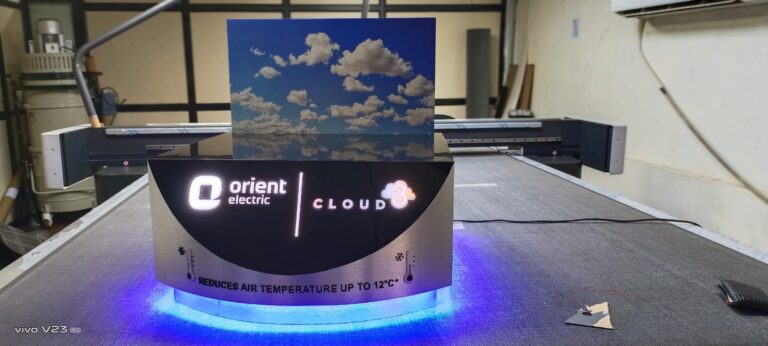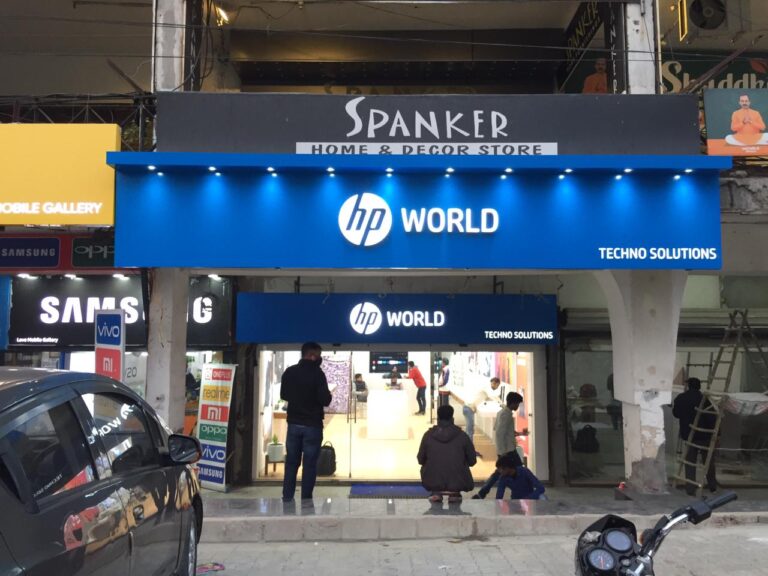
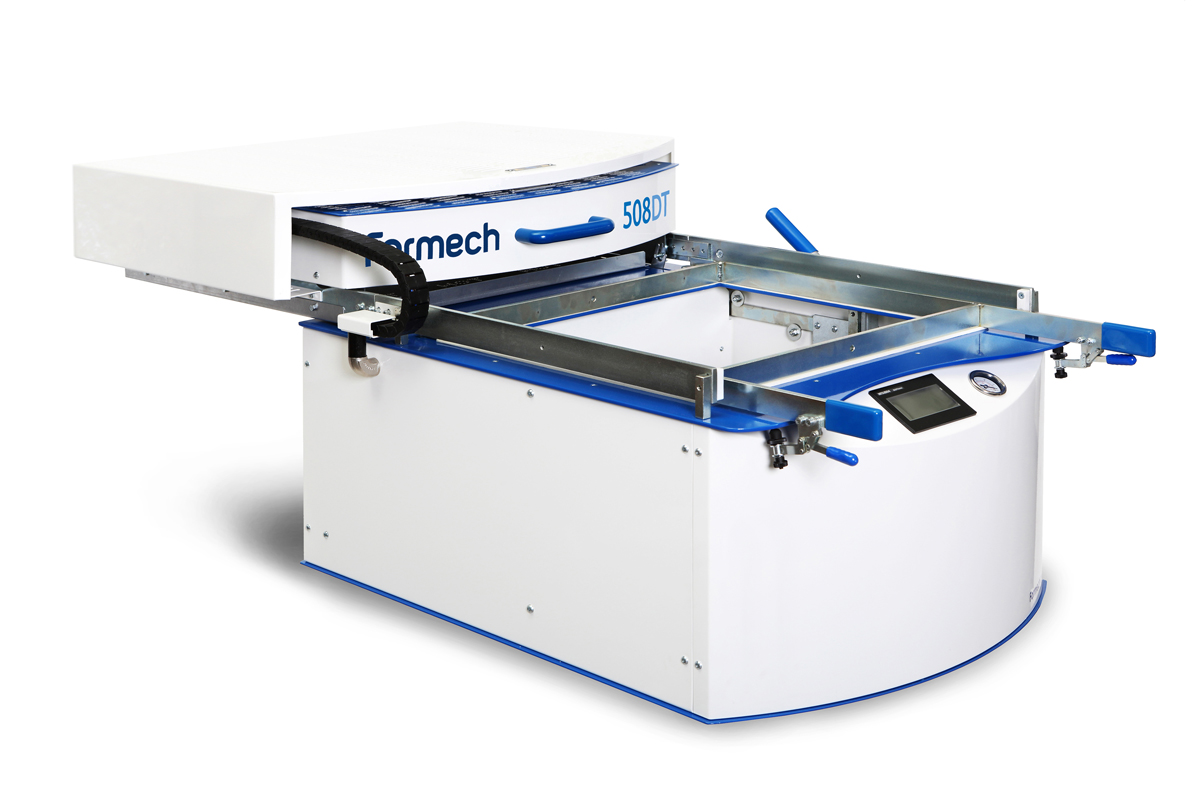
A flat printed logo and a raised, shaped logo can say the same thing and be read very differently. The raised one catches light, casts a shadow and is harder to copy. Vacuum forming is one of the most practical ways to produce that raised version in plastic, in repeatable quantities, for signs, flanges and parts of display fixtures. It is also a capability that many general fabricators do not have, because it needs a forming machine and tooling as well as sheet and print.
This guide explains how the process works, how the three common sheet materials behave, what to choose for indoor, outdoor and illuminated use, and what to put in a brief.
How vacuum forming works
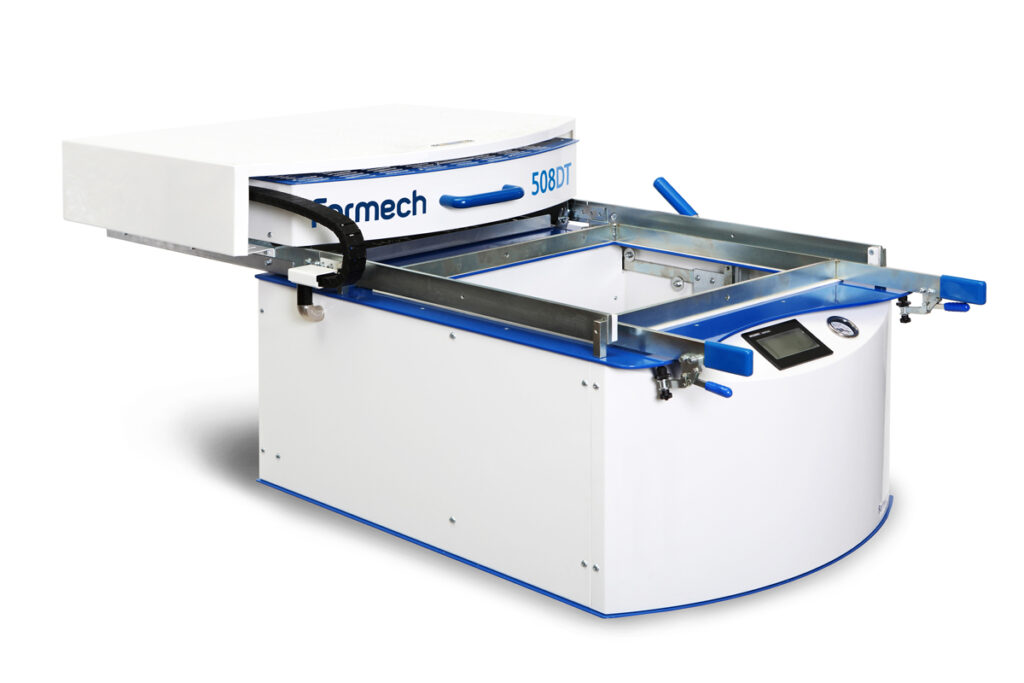
Vacuum forming is a simplified form of thermoforming. A plastic sheet is heated to forming temperature, stretched onto a single-surface mould and forced against it by vacuum. For a branded element the steps are:
- Artwork is turned into a 3D shape, with the depth, edges and draft angles that the process needs.
- A mould, or die, is made. Machined aluminium is typically used for shallow-draw parts in thin-gauge material, and the same source notes that tooling cost is a significant factor.
- The sheet is heated, drawn onto the mould by vacuum and cooled.
- The formed part is trimmed, finished, printed or painted, and assembled into the sign or fixture.
Two design rules recur in forming guides. A draft angle of at least 3 degrees is recommended to release the part from the mould, and corner radii on the mould should not be sharper than the sheet thickness. A logo with sharp inner corners or undercuts may need to be adapted, and a good supplier will tell you before cutting the tool.
The economics: tooling once, parts many times
Because the mould is the main fixed cost, vacuum forming suits repeat use: the same 3D flange on every dealer board, the same formed header on every fixture, the same logo element across a rollout. For one-off signs, other routes such as CNC-cut letters are usually cheaper. Ask the vendor to show the tool cost separately from the unit cost, so you can see where the break-even lies.
Choosing the sheet: acrylic, PETG or HIPS
| Property | HIPS | PETG | Acrylic (PMMA) |
|---|---|---|---|
| Cost | Lowest of the three | Higher than HIPS | Medium to high |
| Clarity | Opaque | Clear | Best optical clarity, about 92 percent light transmission |
| Forming | Forms very easily | The easiest of the three to process, no pre-drying | Narrow forming window of about 150 to 180°C, and it cracks if underheated |
| UV and weather | Fair. Yellows in prolonged direct sun | Good to moderate, grade dependent. Uncoated PETG can yellow outdoors within a season or two | Excellent. Built-in UV stability, about ten years outdoors in one guide |
| Impact | Moderate | High | Lower, brittle |
| Typical retail use | Indoor, temporary, painted or printed parts | Indoor displays and covers, fabricated parts | Illuminated faces, premium and long-term signage |
The sources disagree on PETG’s outdoor performance. One comparison rates its UV resistance as good, another warns that uncoated PETG yellows and crazes outdoors within one to two seasons. The honest reading is that it depends on the grade, the coating and the exposure, so treat PETG as an indoor or sheltered material unless the supplier can show a UV-stabilised grade. ABS with an acrylic cap layer is a further option that adds UV and scratch resistance for outdoor panels.
Illuminated signs and dealer boards
Acrylic is the standard material for illuminated channel letter faces and lightbox panels. For LED-backlit faces the sheet thickness affects how evenly the light spreads, so test a sample on the actual LED layout. For an outdoor dealer board, choose acrylic or a capped material for the formed face. HIPS is better suited to temporary or indoor work. See our guide to LED, neon and edge-lit signage for the lighting side.
Printing and finishing formed parts
Formed parts can be painted, printed or fitted with printed inserts. If graphics are printed on the flat sheet before forming, the ink must survive stretching. A UV printing guide notes that flexible inks matter when a piece will be bent or thermoformed after printing, because a brittle ink film can crack. Many makers avoid the issue by forming first and printing or painting afterwards. Ask which route the vendor uses.
Where it is used in retail
- 3D logo flanges and raised brand marks on shelf-top and wall displays.
- Illuminated faces for dealer and fascia boards.
- Formed headers and shells on display units and fixtures.
- Branded product holders and trays that follow a product’s shape.
- Showroom bay elements where a repeated brand shape is part of the identity, as in automotive and tyre display bays.
A brief for a vacuum-formed element
- Artwork in vector form, with the real size and the viewing distance.
- Indoor, sheltered or outdoor use, and expected life.
- Illumination: none, edge-lit or backlit, and the LED layout.
- Quantity per design and number of designs, so tooling cost can be spread.
- Colour and finish: moulded colour, painted, printed or film-applied.
- Fixing method: how the part attaches to a board, fixture or wall.
- Sample approval before full production.
Frequently asked questions
What is vacuum forming in signage?
A process in which a heated plastic sheet is drawn over a mould by vacuum to create a 3D shape, used for raised logos, sign faces and display parts.
Which plastic is best for vacuum formed signs?
Acrylic is the standard for illuminated and long-term signs, PETG suits indoor and sheltered uses, and HIPS suits low-cost indoor or temporary parts.
Can vacuum formed signs be used outdoors?
Yes, with the right material. Acrylic or UV-capped materials are the safer choices. HIPS and uncoated PETG tend to yellow in sun.
How much does vacuum forming tooling cost?
It depends on size and detail, and tooling is a significant cost. Ask for tool cost and unit cost separately.
Is vacuum forming cheaper than CNC cutting?
For repeated identical parts, usually yes once the mould is paid for. For a single sign, CNC-cut or fabricated letters can be cheaper.
Beyond Retail has vacuum-forming capability in-house at its Delhi NCR facility, listed on its infrastructure page, and uses it for 3D logo flanges and branded elements, including for automotive and tyre displays, alongside its signage and point-of-sale materials work. Send the logo artwork with quantity and use, and we will advise on material, tooling and cost before you commit.