Custom Retail Display Stand Cost in India: Materials, Design, Quantity and Manufacturing Factors
Ask three makers for the price of a custom display stand and you will receive three numbers that cannot be compared, because each assumed a different size, material, print and quantity. The question is fair. What makes it hard to answer is that a stand is not one product with one price. It is a design, a material, a manufacturing route and a delivery, priced separately.
This guide explains the factors that move the cost, what Indian listings show, and how to write a request that produces comparable quotes. If you are still choosing a format, start with choosing a display for a product launch.
Factor 1: material
| Material | Typical use | Cost and life |
|---|---|---|
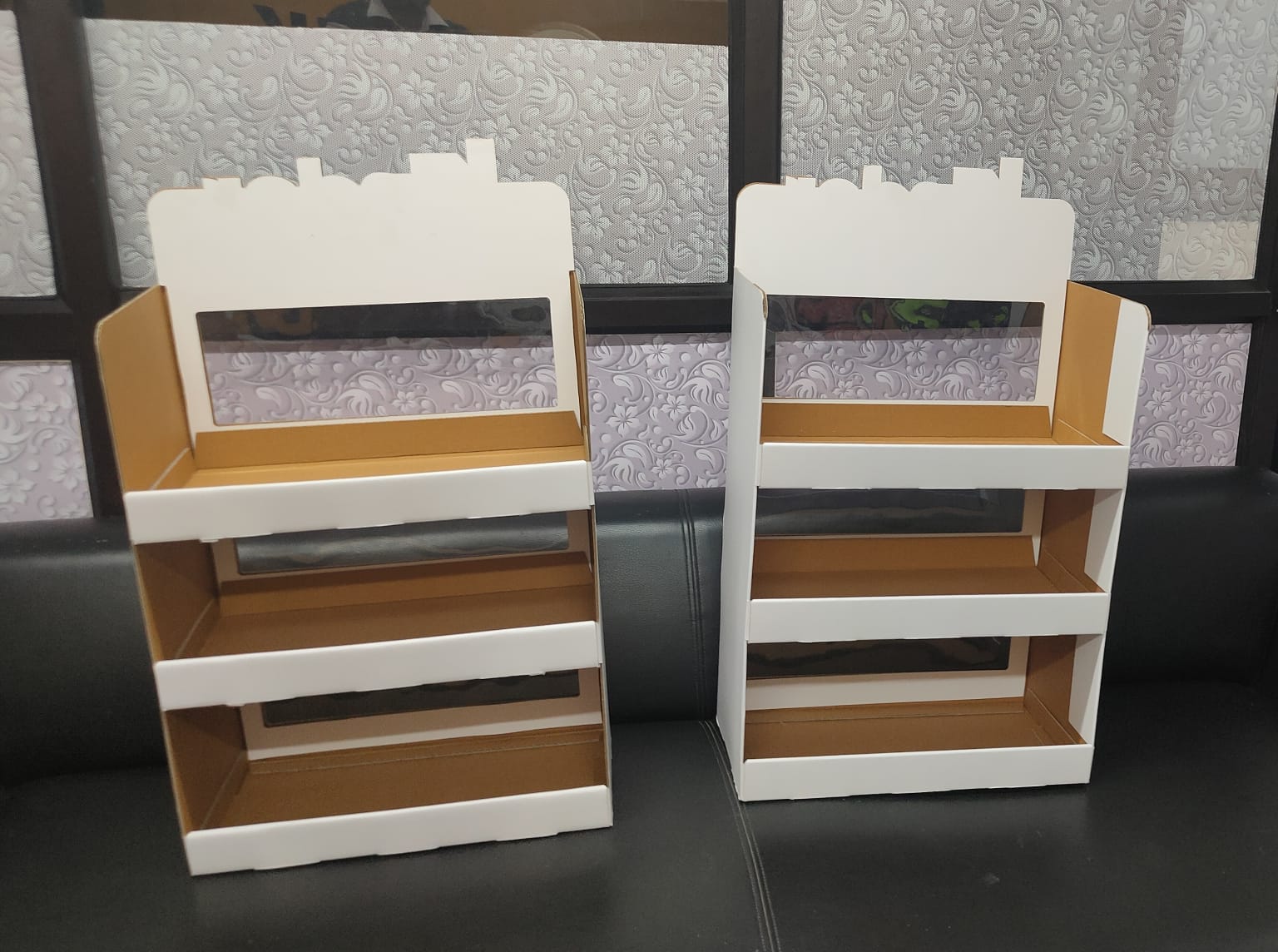
| Corrugated board | Short promotions | Life of about 4 to 12 weeks, lowest unit cost |
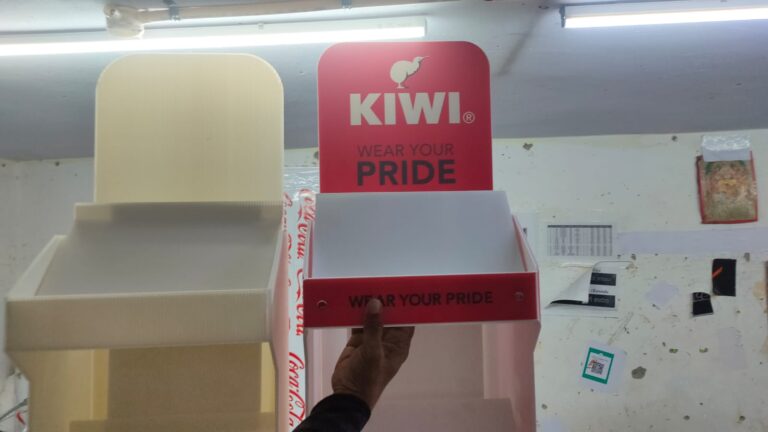
| PP sheet or foamex | Mid-life foldable units | Moderate cost, months of use |
| Acrylic | Counter units, premium looks | Higher cost, clear and printable |
| MDF or laminate | Counters and heavier units | Moderate to high, finish matters |
| Metal | Permanent floor units | Specified when units stay five years or more or hold heavy products; highest unit cost |
For the life-cycle trade-off between cardboard and metal, see our guide to metal FSUs and cardboard POSM.
Factor 2: design and size
Height, depth, shelf count and load per shelf set material use and freight volume. Shaped or illuminated designs add engineering. A new structure also needs a prototype, which adds time. Reusing a structure with changeable graphics is the lowest-cost way to vary a campaign.
Factor 3: quantity and tooling
Cutting dies, jigs and set-up costs are fixed, so more units lower the unit price. MOQs vary: listings below show 5 to 100 for standard formats, and one Gujarat manufacturer quotes around 100 for counter and floor units and 500 for shelf talkers. MOQ is usually counted per design, so changing structure or artwork can create a separate design.
Factor 4: print and finish
Number of printed faces, print method, lamination and backlit panels all add cost. Printing in the same facility as the structure means a graphic change is a file change, not a new job.
Factor 5: the manufacturing route
How a stand is made affects cost, quality and consistency. Beyond Retail’s infrastructure page lists in-house capability that includes UV flatbed and roll-to-roll printing, CNC routing, laser cutting, edge and roller bending, vacuum forming, panel saws and edge banding, as well as direct printing on Sunboard, acrylic, ABS, ACP and poly sheet. In plain terms, wood and board can be cut and edge-banded, metal can be cut and bent, acrylic can be laser cut and bent, and graphics can be printed directly or on film, all without sending work to outside shops.
That matters for cost in three ways. Fewer handoffs mean fewer margins stacked on the same unit. One facility means one colour process, so repeat orders match. And a design change is quicker to correct. Ask any vendor which of these steps it does in-house and which it subcontracts.
What Indian listings show
Public price points exist mainly as supplier listings. They describe standard items, several carry a ‘price on request’ tag, and none includes freight to your cities.
| Item as listed | Listed price | MOQ | Source |
|---|---|---|---|
| Foldable floor display, PP sheet, three shelves up to 6 ft, UV printed | ₹1,250 per piece | 5 | Coimbatore listing |
| Counter top display stand | ₹400 to ₹500 per piece | 10 to 100 | New Delhi listing |
| Foldable display floor stand | ₹3,500 per piece | 100 | New Delhi listing |
| Modular display stands | ₹28,000 per square metre | 1 square metre | New Delhi listing |
| Branded cardboard FSDU | ₹1,200 to ₹5,000 per unit | Not stated | PPMS guide |
| LED-fitted modern trade FSU | ₹15,501 per piece | Not stated | Gurugram listing |
The spread from ₹400 to ₹28,000 is the point. Format, material and size explain it.
Lead time
One Indian vendor states 10 to 18 working days for most formats. Time grows with a new structural design, prototypes, approvals, illumination, festive peaks and delivery to many cities.
How to ask for a comparable quote
- Quantity per design and number of designs.
- Size, shelf count and load per shelf.
- Material preference or the in-store life you need.
- Artwork files, printed faces and finish.
- Flat-pack or assembled.
- Delivery cities and who installs.
- Required in-store date and prototype needs.
- Prices at three quantity levels, for example 100, 500 and 1,000.
Frequently asked questions
How much does a custom display stand cost in India?
It depends on material, size, print, quantity and delivery. Listings show items from about ₹400 to ₹28,000 depending on format, so get quotes against your own specification.
What is the MOQ for custom display stands?
Standard formats show 5 to 100 in listings, and some makers quote 100 or more. MOQ is usually per design.
How long does it take to make a custom display stand?
One Indian vendor quotes 10 to 18 working days for most formats. New structures and prototypes take longer.
Is metal or acrylic more expensive?
Both cost more than corrugated board or PP sheet, and the order depends on size, thickness and finish. Compare quotes on the same specification.
Does Beyond Retail publish prices?
No, because cost depends on the specification. Send your brief and you will get a quote you can compare.
Beyond Retail designs and manufactures display stands in-house in Delhi NCR, with printing in the same facility. See point-of-sale materials and digital printing. For minimum order quantities and lead times, see our guide to custom POSM display stands: cost, MOQ and lead time. Send your brief with quantities, sizes, materials, cities and dates, and we will return a quote structured so you can compare it.