Retrofitting an Existing Store vs. Fitting Out a New Shell: What Changes in the Plan
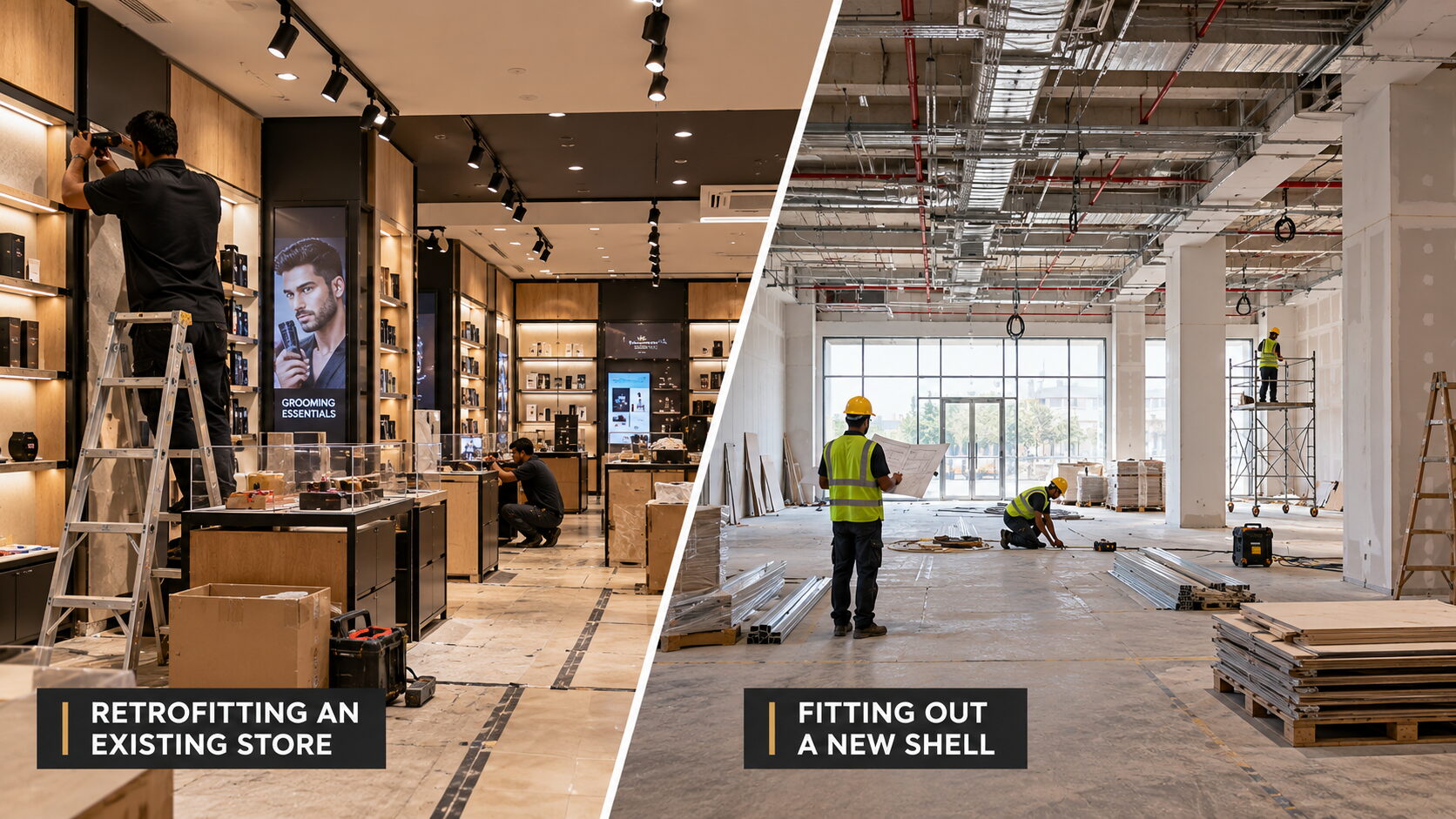
A brand expanding into its fifteenth city rarely gets the clean, empty box its first few stores had. More often it’s an existing unit, sometimes its own older store due for a refresh, sometimes a previous tenant’s leftover fit-out waiting to be stripped out. The planning instinct is to reuse the process that worked for store one. It doesn’t transfer cleanly, because a retrofit and a new-shell fit-out solve different problems even when the finished store looks identical.
Shell condition decides more than people expect
Commercial space generally arrives in one of a few conditions, and the difference matters enormously for planning. A cold or dark shell is the most basic structure, with nothing beyond the building envelope, offering maximum design freedom at the cost of a complete build-out from scratch. A vanilla or warm shell is further along, with basic finishes, lighting and HVAC already in place, which can significantly reduce both build-out cost and time to occupancy. A retrofit of an existing store sits in a third category entirely: second-generation retail space, a unit with an existing fit-out from a prior tenant or an earlier version of your own store, where forcing a new concept into an unsuitable existing layout can create operational compromises and additional costs later.
What a retrofit has that a new shell doesn’t: existing stuff to deal with
The single biggest planning difference is demolition and decision-making about what to keep. A space with an existing fit-out may require demolition of unwanted elements before a new design can be implemented, which can add unexpected cost that a true shell-and-core project never faces. Every retrofit needs an honest audit before design even starts: is the existing storefront glazing structurally sound and worth reusing, or does it need replacing? An existing system may still work well if the framing is structurally sound, dimensions fit the new layout, doors operate correctly and the appearance works with the new design, but forcing a mismatched old storefront into a new concept rarely ends well. The same question applies to flooring, ceiling grids, electrical capacity and HVAC, each one either a cost saving if it’s reusable or a hidden cost if it’s assumed reusable and turns out not to be.
A retrofit often has to work around a trading store, a new shell never does
This is the planning difference that catches people out most. A new shell is empty; nobody is losing trading hours while it’s built. A retrofit of an operating store, as opposed to a full strip-out between tenants, frequently has to be sequenced in phases so part of the store keeps trading while another part is rebuilt, which adds coordination complexity a new-build project never has to think about. Even a full strip-out retrofit usually runs on a tighter, more compressed timeline than a new shell, because the store is losing revenue for every day it’s shut, in a way an as-yet-unopened new location isn’t.
Side-by-side comparison
| Factor | New shell (vanilla or cold) | Existing-store retrofit |
|---|---|---|
| Design freedom | High; nothing to remove or work around | Constrained by what’s structurally fixed (columns, risers, storefront position) |
| Hidden costs | Mostly predictable from the shell’s known condition | Demolition surprises, outdated wiring, non-reusable elements discovered mid-project |
| Trading impact | None; store isn’t open yet | Lost trading days, or phased work if the store stays partly open |
| Timeline pressure | 6 to 14 weeks is typical for a vanilla shell light fit-out; longer for a cold shell | Often compressed to the shortest tolerable closure window, regardless of scope |
| Reusable assets | None, by definition | Potentially storefront, flooring, ceiling, electrical capacity, if structurally sound |
Deciding which approach a given project actually is
Before anyone designs a single fixture, settle the shell question explicitly: is this project a true build-out starting from a shell, or a remodel adapting an existing operational space, because the two call for different contractors, different sequencing, and different budget contingencies. Key factors in choosing an approach include budget availability, project timeline, existing store condition, branding goals and expansion strategy, and a brand that mislabels a retrofit as a straightforward fit-out usually discovers the mismatch through an unplanned cost overrun partway through.
Practical implications for the fixture brief
- Commission a shell condition survey before finalising any fixture design, not after, so dimensions and structural constraints are known rather than assumed
- Decide explicitly which existing elements will be reused, replaced, or audited for structural soundness, and get that in writing before production starts
- Build demolition and disposal into the budget and timeline for a retrofit; a new shell never carries this cost
- If the store must stay partly trading, sequence the fixture delivery and installation to match the phased construction plan, not the ideal single-day handover a new shell would get
- Expect a retrofit’s realistic timeline to be compressed by trading-loss pressure rather than scope; plan the fixture production schedule backwards from the shortest tolerable closure window
Beyond Retail’s turnkey showroom and fixture execution work covers both new-shell fit-outs and store renovations, and its 3D design process can incorporate an existing shell’s constraints rather than assuming an empty box. If you’re planning a retrofit of an existing location and need the fixture plan built around what’s already there, share the site survey or existing drawings and the design can start from the real conditions rather than a generic template.
Sources
- MaxxBuilders, Guide to 4 Different Types of Shell Structures
- NAM Creations, Shell and Core vs Fit-Out
- Commercial Storefront Glass, Retail Store Build Out
- Emerald Inc, Gray Shell vs Vanilla Shell: What's the Difference & What Will It Cost?
- Prime Retail Services, Retail Build-Outs Explained: From Shell to Store Opening
- Prime Retail Services, Key Differences Between Retail Build-Outs and Store Refreshes